April 1, 2026
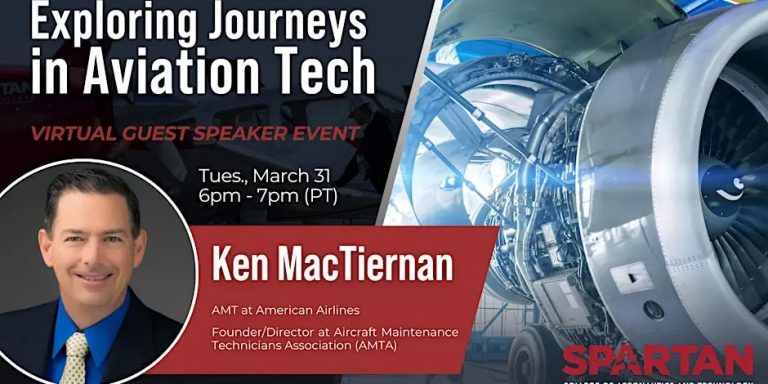
Aviation Maintenance Insights: Q&A with Ken MacTiernanSpartan recently welcomed aviation maintenance leader Ken MacTiernan for a special virtual event where students, alumni, and aviation enthusiasts gained firsthand insight into training to prepare for entry-level employment in aircraft maintenance.
With nearly four decades of airline maintenance experience, MacTiernan began his aviation journey as a U.S. Air Force B-52 mechanic and went on to build a distinguished career in commercial aviation. Beyond his technical work, he has become a passionate advocate for the aircraft maintenance profession, founding the Aircraft Maintenance Technicians Association (AMTA) and serving in leadership roles that support workforce development across the industry.
During the session, MacTiernan shared lessons from his career, advice for aspiring technicians, and perspectives on the future of aviation maintenance.
Below are key takeaways from our conversation:
Q. What first drew you into aviation maintenance and how did this experience shape your career?
A. I was drawn into aviation maintenance because I actually wanted to fly airplanes in my senior year of high school. After talking to military recruiters I was told I couldn't fly because I wore glasses. So I thought, okay - if I can't fly them I want to fix them. By becoming a USAF B-52 Mechanic it gave me the opportunity to gain experience working on "big jets" while I attended a local community college to earn my airframe & powerplant certificates. This experience coupled with these certifications opened the door to working in the commercial aviation sector after my honorable discharge.
Q. Can you explain the importance of your certifications and the impact they can have on someone’s potential in this industry?
A. Becoming certificated as an Airframe & Powerplant Technician is HUGELY important in order to work for a commercial airline. This is because the airlines require their Aircraft Maintenance Technicians (AMTS) to have both certificates. The airframe certificate allows me to work on the entire aircraft EXCEPT the engines. The powerplant certificate allows me to work ONLY on engines. By having both certifications I can work on the ENTIRE aircraft. The impact of having both certifications allows an individual to become more knowledgeable & experienced. It also allows an individual to take this knowledge and experience into a leadership role, such as a Lead AMT or supervisor/manager.
Q. With almost 40 yearsinairline maintenance, what has kept you committed to your profession for this long?
A. There are several different answers to this question. The first is I MUST stay committed because my job is ensuring the safety of both the passengers and flight crews that fly on the aircraft I repair. Secondly, working with like minded professionals who all believe that our profession looks at "perfection is our minimum standard" solidifies this commitment. Then there is the fact that there is always something new to learn working on different fleets of aircraft whether it's an Airbus A319/320/321 or A321NEO, or a Boeing 737 NG (Next Generation) or 737 MAX or a Boeing 777 or 787. Having fun doing what I do helps to stay committed. Being able to laugh with coworkers and knowing that if I ever need help I am simply one ask away from getting that help. Working as a team solidifies this commitment.
Q. For students exploring aviation maintenance training, what should they look for in a program to help prepare them for the real world? What questions should they ask?
A. Students should look for what their ultimate goal is. Do they wish to earn an Associates Degree or a Bachelor's Degree? Entering this profession actually offers an opportunity for students to earn either at their own pace. Enrolling in a trade school that teaches how to become an aircraft maintenance technician, such as Spartan, enables a student to become certificated and enter the workforce.
When looking for a school students should first go visit the school. Look at the school's labs. Look at the school's class schedules. Many schools have evening classes which is great for students to work in the day then attend school. Look at whether a school has scholarship and grant opportunities. Look if a school assists in purchasing tools. Students should ask if a school has a job placement program to assist students after graduating and becoming certificated.
Q. What separates a good technician from a great one?
A. Dedication and passion for the craft. As in any profession mistakes are made. For example you may order the wrong part to repair a fault on the aircraft. It can be embarrassing but don't hide from this mistake. Don't deflect the mistake. Take ownership of. Why? Because that is how you grow as a professional. Learn from your mistakes. Also, offer help when asked for help. Why? because no one knows everything. Not even a person with almost 40 years in commercial aviation maintenance. :) Never stop learning. After repairing an aircraft and you have time, research the manuals and become more aware of how the system you worked on operates. Understand how the different components interact. When finished with a job, clean up after yourself. Don't make others clean up after you. If you empty a oil/hydraulic bowser or use the last of the nitrogen from a nitrogen cart after filling a tire refill the bowser, replace the nitrogen bottle. There isn't just one thing that differentiates being a good technician from a great technician. The difference consists by having a passion for always wanting to elevate yourself and helping others on that journey.
Q. What motivated you to create the Aircraft Maintenance Technicians Association (AMTA) and elevate and advocate for your profession?
A. Honestly? Embarrassment. Back in 2002 an AMT posted on a website about an AMT Day Resolution passing in California, honoring Charles E. Taylor who was the Wright brother's mechanic and is considered the "Father of aircraft maintenance". After reading about who Charlie was I felt embarrassed that here I am, an AMT for AA and ex-USAF B-52 Mechanic, and I never heard about this guy. I felt an injustice had been done. After all, the Wright brothers deserve EVERY ounce of recognition and respect and gratitude for what they did. Not only for the United States, but the world. Orville & Wilbur always gave Charlie the recognition he earned by building the first engines for the Wright Flyer. Sadly though, the Wright brothers passed before Charlie did and history quickly forgot his contributions. So, to help "right a wrong" I created the AMTA and with support from other AMTS we were able to have other States pass their respective AMT Day Resolutions. The AMTA also was able to have the US Senate and US Congress pass their respective AMT Day Resolutions. The AMTA has raised funds to donate beautiful, almost lifelike, bronze busts of Charles E. Taylor to different museums and organizations within the aircraft maintenance community. This continues to be done in order to advocate for a profession that goes largely unseen by the public. As professional AMTs that maintain aviation around the globe the limelight and recognition is not sought after. As a whole, AMTs wait for a problem to arise, address the problem, fix the problem... then wait for the next problem. With more than 120 years of aviation since the first powered, controlled aircraft flew this recognition has been earned. By promoting Charles E. Taylor the AMTA is able to advocate for the thousands of men and women who have followed in his footsteps.
Q. From your leadership roles in the Aerospace Maintenance Council (AMC) and other organizations, what trends are shaping the future of aviation maintenance?
A. Mostly the making aware of this craft & profession to young students. As a high school student I was not aware of how aircraft were built and repaired. It was just taken for granted that "someone" fixed aircraft. With the creation of the AMC and sponsoring a global competition for AMTs we are helping get the word out. This helps shape the future because it opens this profession to an even wider range of technical savvy people who enjoy working with their minds and hands. With young students who are more comfortable working with laptops, tablets and loading software this helps those entering this profession with a smooth transition into working on aircraft.
Q. What would you advise someone graduating high school today and considering AMT training?
A. If you enjoy problem solving. If you enjoy working with your mind and hands. If you enjoy technical problem solving. Consider being an AMT. There is a personal satisfaction knowing that you repaired an aircraft and put that aircraft back into service so people can safely fly to their destination... a business meeting, a vacation, a party or a family gathering. This job is for you! I would also advise young people to not feel overwhelmed when first entering training or their first days at an airline. There is a lot to learn, but you can do it! Everyone starts at step one. You will learn and work as a team with your fellow students as you are guided by your instructors. You will learn and work as a team as an airline AMT as you are guided by senior AMTs and instructors at your airline. Remember what I said about always learning something new? Airlines have training departments to teach you how to work on their aircraft. Enjoy your journey! Learn from those who came before you and teach those who come after you.
MacTiernan’s career journey highlights the critical role Aircraft Maintenance Technicians play in aviation safety and global mobility every day. Events like this reinforce Spartan College’s commitment to connecting students with industry leaders who bring real-world perspective into the learning experience.
Spartan College of Aeronautics and Technology’s Aviation Maintenance Technology program provides hands-on training designed to help students train for the technical skills, industry knowledge, and certifications needed to pursue opportunities as an Aircraft Maintenance Technician.
Click here to learn more about how to further your education in Aviation Maintenance Technology today!
The views expressed in this interview are those of the speaker and reflect their individual experience and professional opinions. FAA Airframe and Powerplant certification requires passing FAA-required written, oral, and practical examinations. Completion of a training program does not guarantee certification, employment, or specific salary outcomes. Employment and earnings vary based on employer, geographic location, certifications, experience, and individual performance.
Affiliate Partner Program | Jobs at Spartan | Terms of Use | Privacy Policy | Opt-out Policy | Privacy Notice - California Residents| Notice of Non-Discrimination | Website Accessibility Help | Transparency in Coverage Act| Cookie Settings | AI Reference Page | LLM Info (TXT)
© 2026 SPARTAN COLLEGE OF AERONAUTICS AND TECHNOLOGY. ALL RIGHTS RESERVED.