February 11, 2026
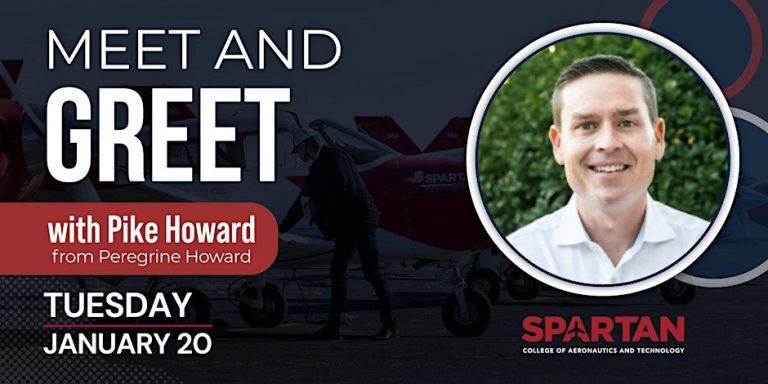
Aviation Entrepreneur Pike Howard Shares Aircraft Ownership and Pilot Career InsightsSpartan Education Group, LLC recently welcomed aviation entrepreneur, aircraft owner, and industry advisor Pike Howard for a special guest session with Spartan students, Certified Flight Instructors (CFIs), and aspiring aviation professionals. The event delivered real-world insights into pilot career development, aircraft ownership responsibilities, aviation safety, and the operational realities of flight training, reinforcing Spartan’s commitment to aviation education.
Pike Howard brings a diverse background spanning aviation, entrepreneurship, and community leadership. Howard holds a commercial pilot license in single-engine and multi-engine aircraft, an instrument rating, and has logged more than 1,600 flight hours. He is type-rated in the L39C Albatross and the C525S Citation jet. His primary flying includes operating his TBM 700B and L39 while also performing contract flying across multiple aircraft platforms. In 2023, Howard co-founded Peregrine Howard Aviation, a company that leases Cessna, Piper, and Diamond training aircraft to flight schools nationwide, currently owning and leasing approximately 50 aircraft.
1. What originally drew you to aviation, and how has owning and operating aircraft shaped your perspective on pilot careers today?
The thing I love about aviation is twofold:
2. From the aircraft ownership and leasing side, what are the biggest realities around costs, utilization, and responsibility that most pilots don’t fully appreciate during training?
You are stepping into one of most expensive machines out there. There isn't a plane probably out here on this ramp that you want get into that maybe doesn't cost much less than half a million dollars.
Sure, its a machine, but its complicated, and demands your respect and attention to detail. "Oh its just a trainer". No its really not, it has wings, an engine, and lots of things that have to go right for it to work, therefore never shy away from a squawk, something seems off, and you will find you respect the machine and it respects you.
This it not a toy. Lots of money, hours, and time have gone into putting you into that seat to take flight, make sure you never take that for granted in starting out even in training.
Not understanding the complexity and cost of a mistake right out of the gate can be a slippery slope. This is where the seriousness and professionalism of your approach to the craft began to take shape.
3. For Spartan student pilots and CFIs, how does understanding the business and operational side of aircraft ownership help make them stronger pilots — even if they never plan to own an aircraft themselves?
It truly boils down to the notion of really understanding your aircraft and its systems. This is why I would implore you to get your hands dirty with maintenance professionals. You began to see and understand the systems at a level that truly allow you to operate aircraft safer and save yourself a ton of time an energy diagnosing. Most importantly it allows you to better discern between what is a problem that truly declares an emergency.
4. For pilots or CFIs who may one day consider aircraft ownership or partnerships, what lessons do you wish you had known earlier in your journey?
The first is as alluded to above, I spent more time with A&Ps. The second is really understanding how aircraft insurance works, side note: they really control your ability to get into a cockpit, not the FAA, and the third would be that having a partner in ownership can really be huge. I went at it alone for a few planes, and you truly don't have to. Find somebody you trust and you knows aligns with your values on safety and finances and you just cut your bill in half. The last is also how aviation can play an important role in business. It will always be expensive to operate and tough to truly justify, but having a business reason to deploy aviation makes it a lot more palatable.
5. When you look at pilots through both an owner’s and advisor’s lens, what behaviors or habits signal that someone is ready for greater responsibility and long-term success in aviation?
Pretty simple — when they start thinking about scenarios that shows a level of systems knowledge and personal limitations that reaffirms they did the work to truly understand it.
A great example is the Citation 525 series. When would you tell a customer "NO" who wants to go to Aspen in his light jet or to take it a layer deeper under what circumstances would you say "YES"?
Speaker experiences, credentials, and career perspectives reflect individual opinions and outcomes and are not typical of new graduates.
Flight training prepares students for entry-level pilot roles. Employment, certifications, and career advancement are not guaranteed and depend on individual circumstances, additional training, experience, and other external factors.
Affiliate Partner Program | Jobs at Spartan | Terms of Use | Privacy Policy | Opt-out Policy | Privacy Notice - California Residents| Notice of Non-Discrimination | Website Accessibility Help | Transparency in Coverage Act| Cookie Settings | AI Reference Page | LLM Info (TXT)
© 2026 SPARTAN COLLEGE OF AERONAUTICS AND TECHNOLOGY. ALL RIGHTS RESERVED.